I bought three leak sensors because there are a couple of places in the house where I would rather get an annoying phone notification than discover a slow leak much later.
The first place is under the kitchen sink, next to the reverse osmosis system we use for filtered water. The second is under the bath, where I recently fitted a replacement pump for our whirlpool bath. Both are exactly the sort of places where a small leak can sit quietly for a while before it becomes obvious.
I ordered one sensor from Sonoff, one from Moes, and one from Meian. This is not a careful long-term review yet. It is more of a first setup note: what Home Assistant saw, where I placed them, and the small trick I used to make them more likely to notice a drip.
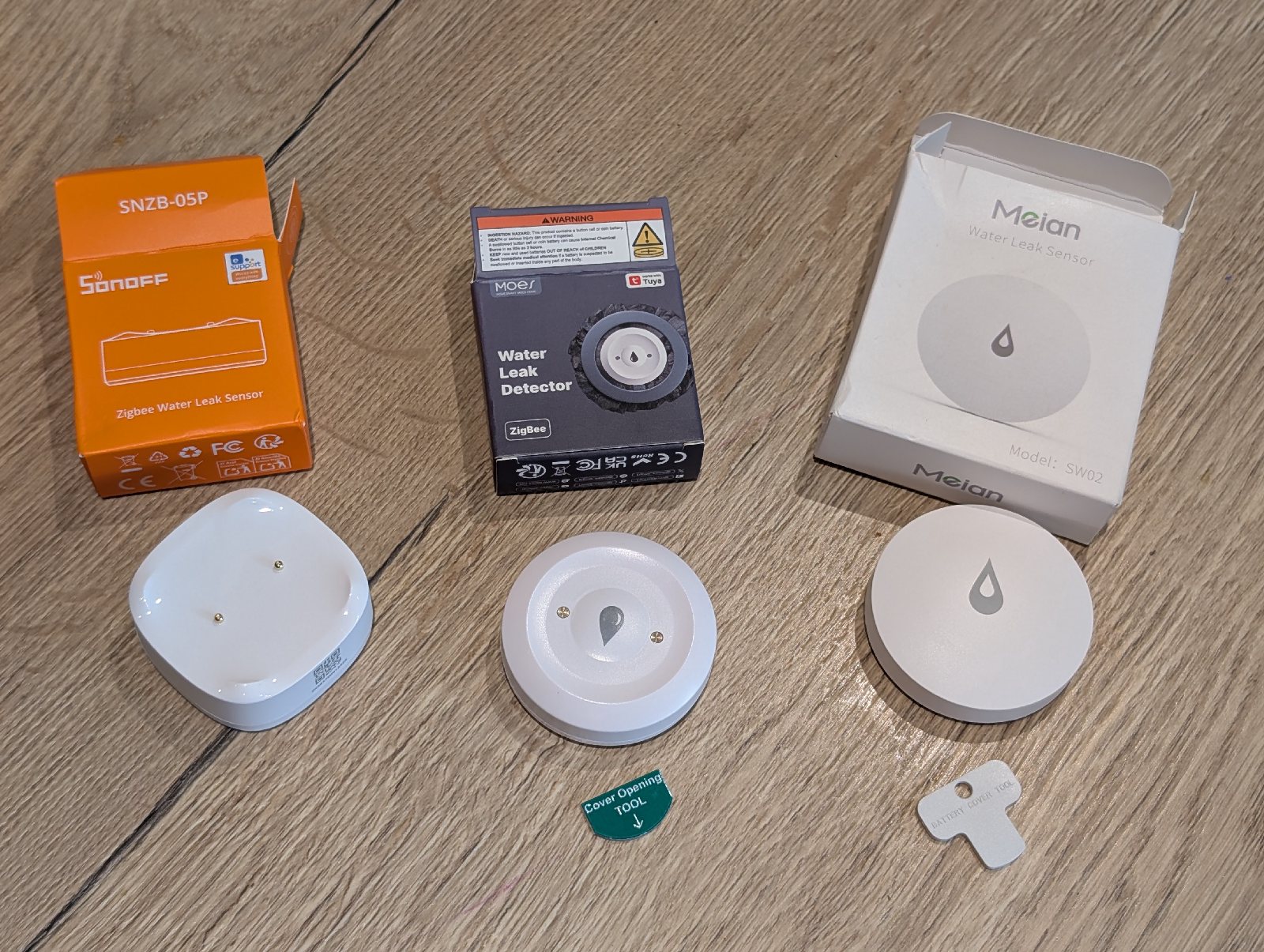
The three sensors from the front. They are all doing the same basic job, but the shape and thickness are slightly different.
The Sensors #
All three sensors exposed the same basic thing in Home Assistant: a binary water leak value. If the contacts are dry, it is false. If water bridges the contacts, it becomes true.
That is the important bit. I do not need a percentage, a moisture level, or a clever classification. For these locations, the useful question is very simple: is there water where there should not be water?
The differences were small but still worth noting.
| Sensor | Leak detection | Tamper detection | Battery note |
|---|---|---|---|
| Sonoff | Yes | No | Battery included |
| Moes | Yes | Yes | Battery included |
| Meian | Yes | Yes | Needed a CR2045 |
The Meian sensor did not come with a battery, so I had to open it up and put one in. Luckily I already had a CR2045 kicking about, otherwise that would have been a slightly annoying pause in the setup.
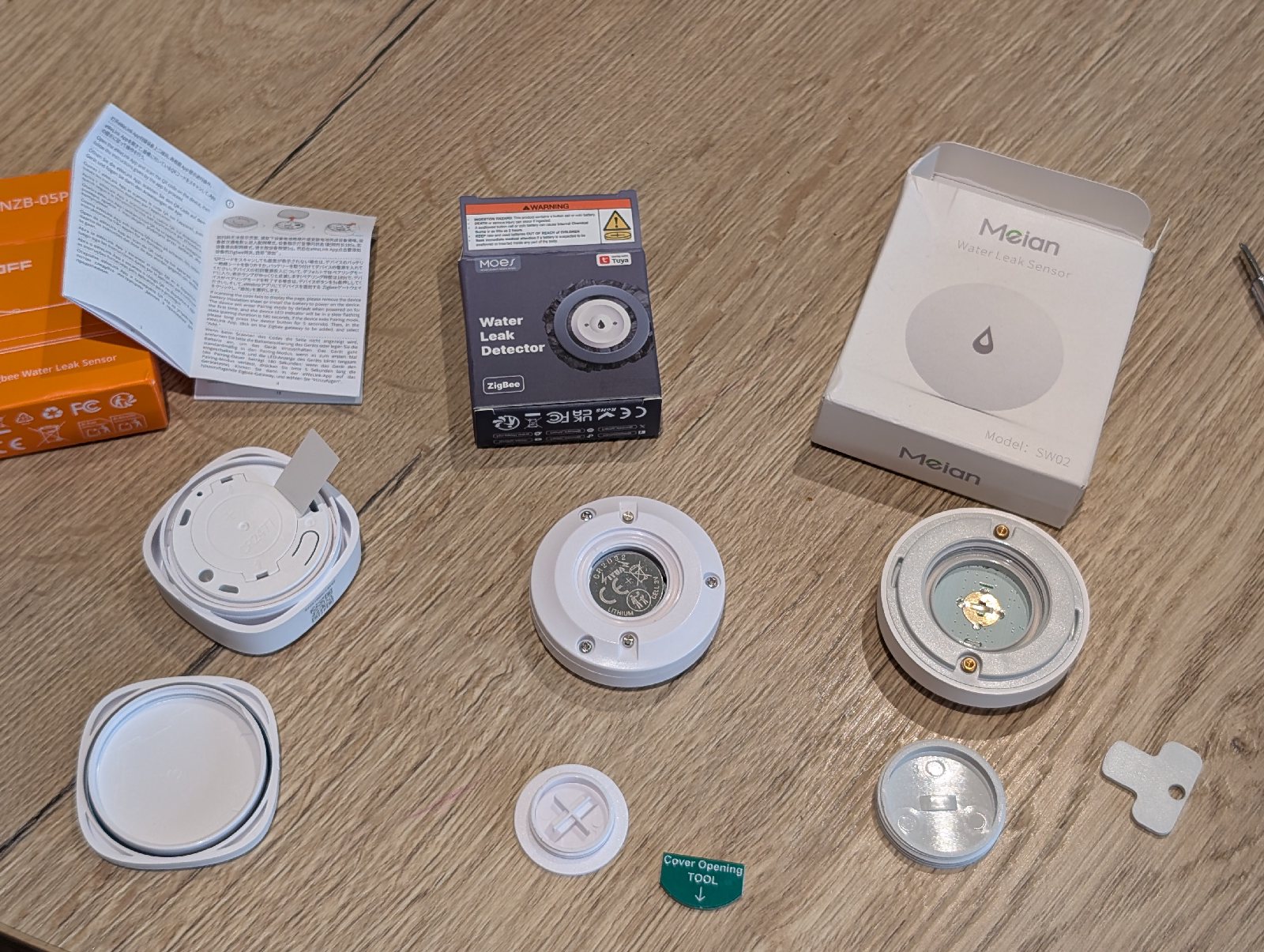
The Meian sensor was the awkward one here because it arrived without a battery. The others were ready to pair once opened.
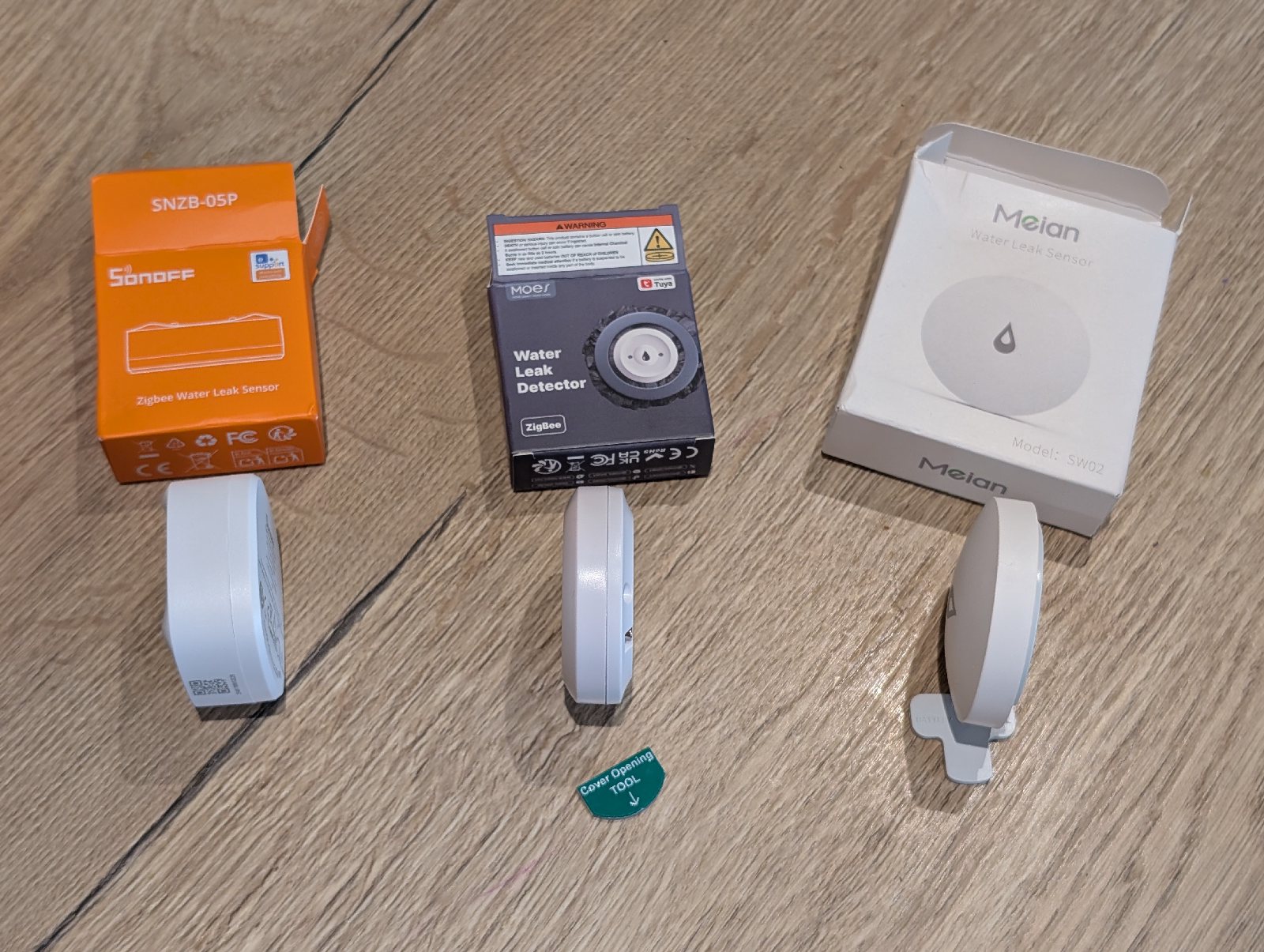
Side-on, the difference in thickness is easier to see. It is not a huge issue, but it can matter if the sensor needs to sit under pipework or in a tight corner.
Tamper Detection Is More Useful Than I Expected #
The Sonoff sensor only gives me the leak state. The Moes and Meian sensors also expose a tamper sensor, again as a simple boolean.
At first that sounds like a security feature, and in this use case I do not really care if someone is trying to steal a leak sensor from under the bath. But the more practical use is position.
A leak sensor is only useful if it is still sitting in the place where a leak would actually reach it. If it gets knocked, moved, or lifted out of the little low point where I placed it, then the automation can still look healthy while the physical setup has stopped making sense.
The leak state tells me whether the sensor is wet. The tamper state can tell me whether I should still trust where the sensor is sitting.
I have not yet built anything elaborate around the tamper sensors, but I can see the shape of it: if a sensor is tampered with, send a notification saying it may have moved and might not detect a leak reliably. That is a much more useful alert than treating tamper as only a security event.
The Kitchen Tissue Trick #
For both locations I placed the sensors on kitchen tissue.
That is not because the sensors need cushioning. It is because a tiny drip can be surprisingly local. If a single drop lands a few centimetres away from the sensor contacts, the sensor may not know anything has happened until enough water builds up and spreads naturally.
Kitchen tissue changes that. A drip landing on the tissue spreads along it, which gives the water a better chance of bridging the sensor contacts early.
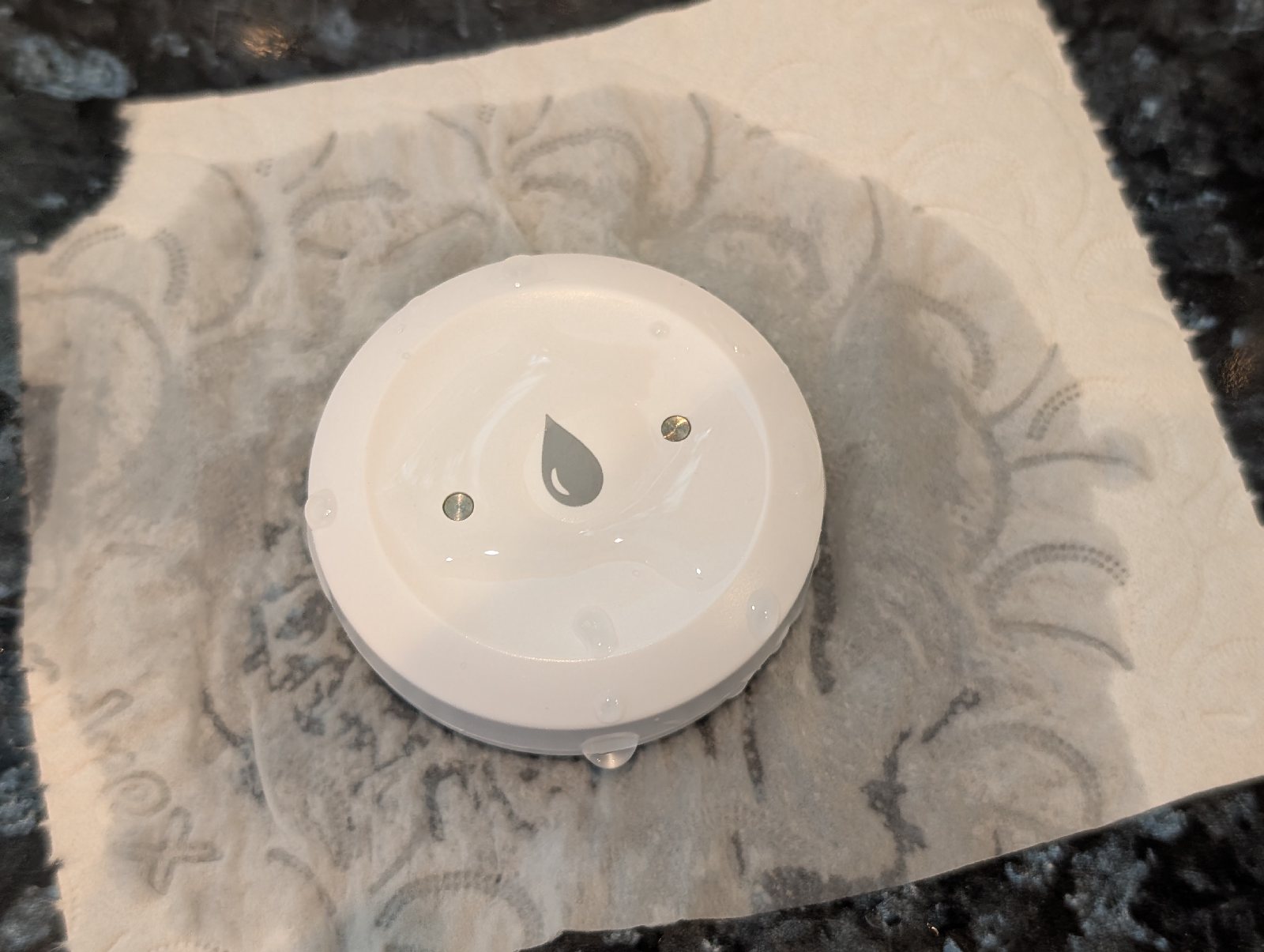
The tissue is there to help a small drip travel. It is a very basic way of making the sensor less dependent on water landing in exactly the right spot.
It is a low-tech addition, but it makes sense for the kind of leak I am trying to catch. I am not really worried about a pipe bursting dramatically. I am worried about a push-fit connection, pump seal, or pipe joint slowly weeping somewhere awkward.
Under The Sink #
One sensor went next to the reverse osmosis system under the kitchen sink.
The RO system has push-fit connections, and although they are common and usually fine, I do not really trust them not to leak over time. That might be unfair, but it is exactly the kind of small risk that a cheap leak sensor is good at covering.
I placed the sensor on kitchen tissue near the pipework so that if a drip starts, the tissue should help the water travel to the contacts rather than waiting for the whole area to become wet.
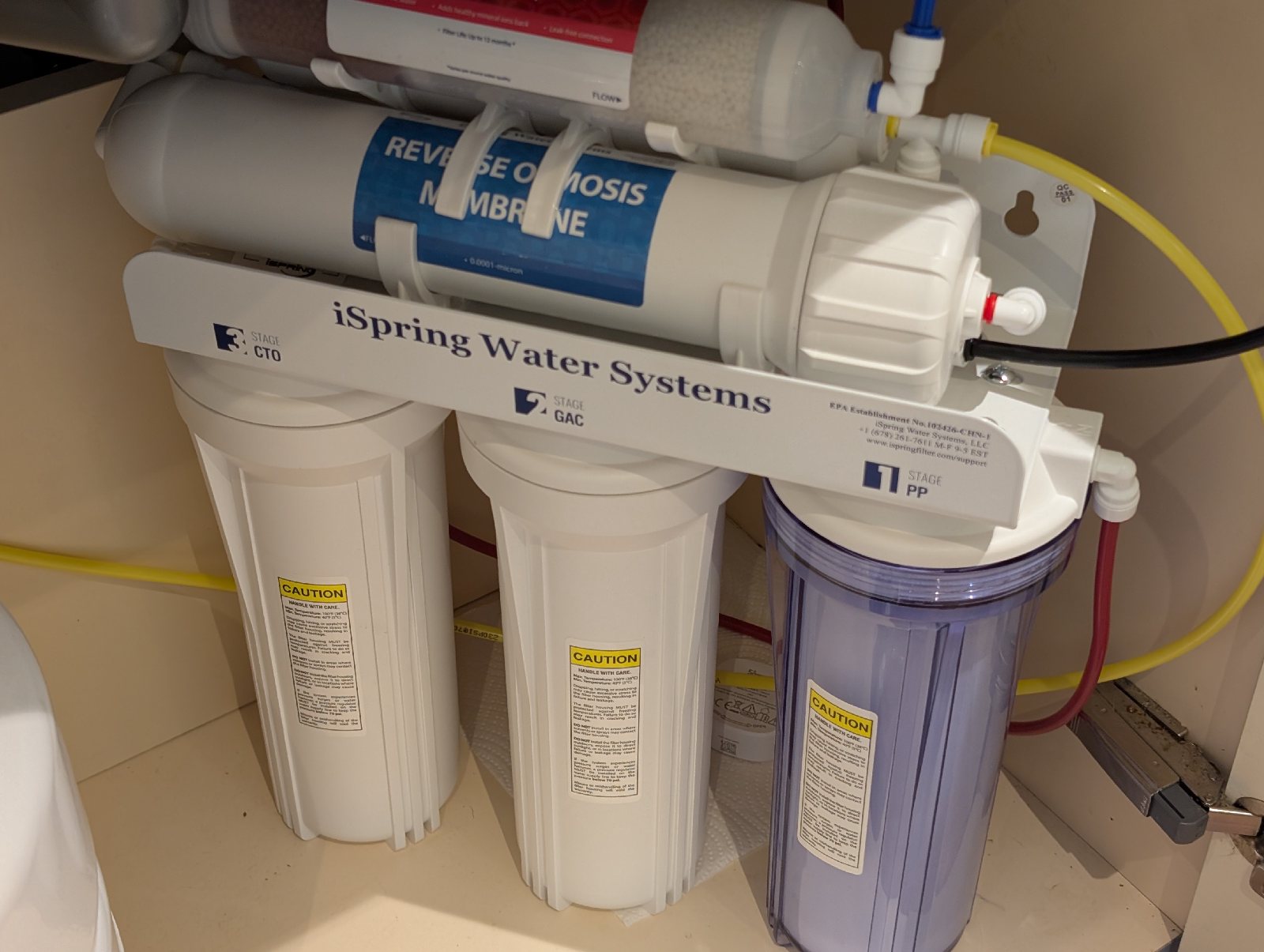
This is the one next to the reverse osmosis system under the sink. The push-fit connections are the bit I want early warning on.
This is probably the neatest use case for these sensors. The area is enclosed, there is plumbing I cannot see during normal use, and the consequence of missing a slow leak is much worse than the consequence of a false alarm.
Under The Bath Pump #
The bath pump setup is the more personal one, because I fitted the replacement pump myself.
For some reason, the plumbers I spoke to did not seem keen to touch it. They made it sound more complicated than it turned out to be, so in the end I replaced it myself. It works, but that does not mean I completely trust my own plumbing work to stay perfect forever.
I used sealant around the pipes, especially near the connection by the heater, but I still wanted something watching it over time. The bath is also a larger area than the RO system, with more possible leak points, so I put two sensors under there rather than one.
One sits under the pump itself. The other sits further back near the heater connection, where I used the sealant.
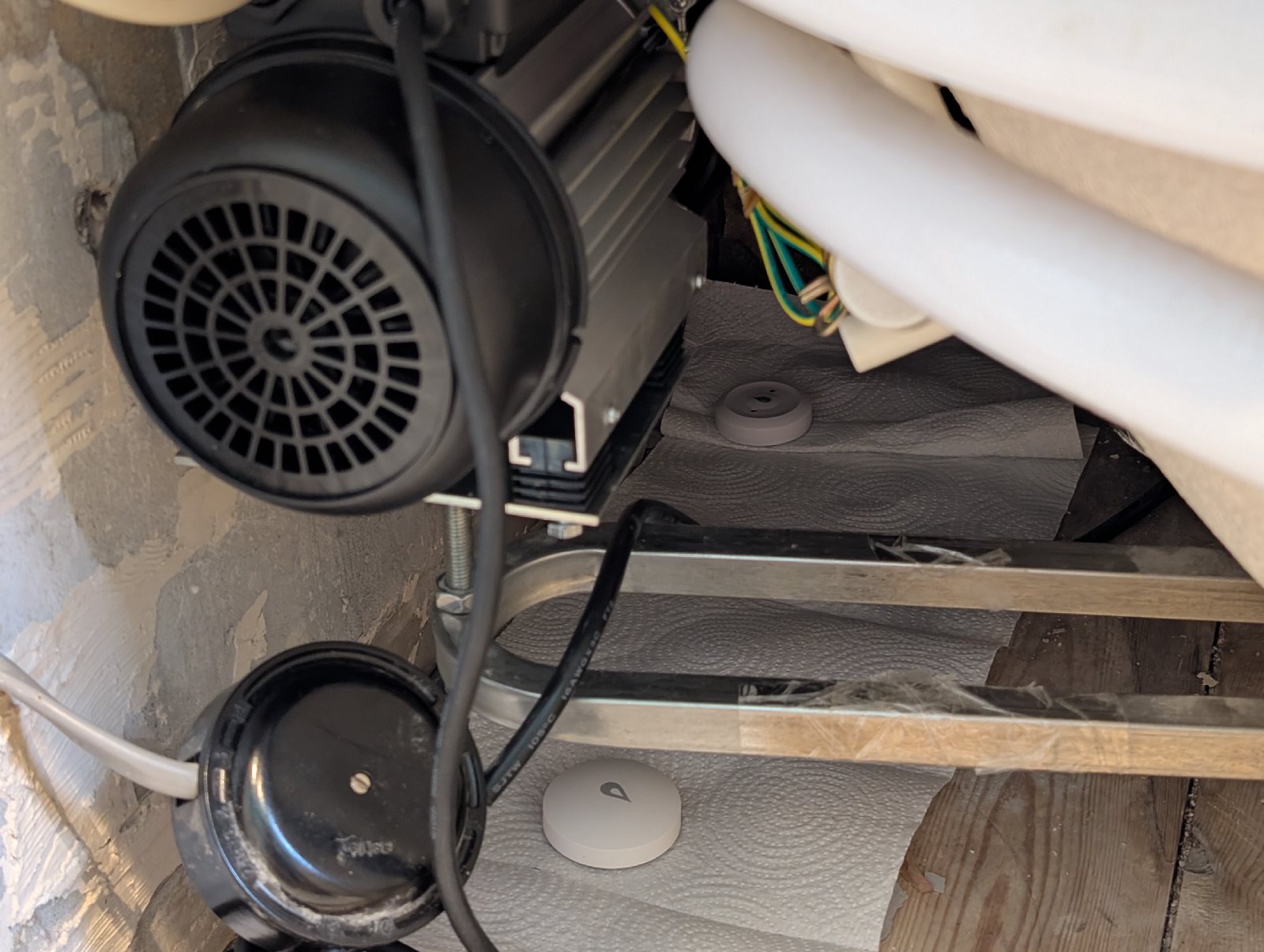
Under the bath I used two sensors because the area is larger and there are a few different places that could leak.
Again, both are on kitchen tissue. The goal is to catch small drips before they become a damp patch, not to wait until there is enough standing water to make the detection obvious.
The Home Assistant Automation #
The Home Assistant side is deliberately boring.
Each sensor exposes a binary water leak value. If any of those leak sensors changes to true, Home Assistant sends a notification to me and my wife so we both get it on our phones.
The automation is not trying to be clever about severity or location yet. I mostly want the fast path to work:
leak sensor becomes wet
  -> Home Assistant sees water leak = true
  -> phone notification goes to both of us
  -> go and check the physical location
That is enough for this first version. A leak is one of those automations where I do not want a lot of interpretation in the middle. If the sensor thinks there is water, I want to know quickly and decide what to do myself.
First Impression #
For a small setup, I like this more than I expected.
The sensors are not doing anything complicated, but that is probably why they are useful. They turn a hidden physical problem into a simple Home Assistant state, and that state is easy to notify on.
The only thing I would think about more carefully if buying again is tamper detection. I would not treat it as essential everywhere, but for leak sensors that can be knocked out of place, it is a more practical feature than I first gave it credit for.
The next version of this note could do with a bit more detail after the sensors have been sitting in place for a while. For now, the important part is done: the places I do not fully trust are the places that will shout at me if they get wet.
Some of the product links in this post are affiliate links.