Indoor activity
Tin Foil Boat Challenge
Fold a sheet of tin foil into a boat, float it in a bowl of water, and discover how many coins it can hold before sinking!
Materials
- Aluminium Foil
- Coins
- Large Bowl
Illustrated Steps
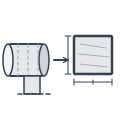
Tear Your Foil
Tear off a 25cm square of aluminium foil and smooth it flat on the table.
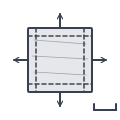
Fold Up the Sides
Fold each of the four edges up about 2cm and press firm creases to make a shallow tray.
Pinch the Corners
Press the overlapping corner flaps flat against the inside wall to seal all four corners.

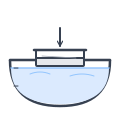
Float Your Boat
Fill a large bowl with 10cm of water and gently lower your foil boat onto the surface.
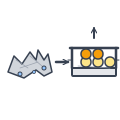
Load the Cargo
Place coins one at a time into the centre of your boat and count how many it holds!

Redesign and Beat Your Record
Flatten your foil and fold a new boat with taller walls or a wider base, then test again.
What You’ll Create
You’re going to become a naval engineer for the day! 🚢 Using just a sheet of aluminium foil and some clever folding, you’ll build your very own boat and test how much cargo (coins!) it can carry before it sinks. The challenge: can you redesign your boat to beat your own record?
Every time your boat sinks, you learn something new about how weight and shape affect floating — the same principles real ship designers use! ⚓
Have fun!
- 🏆 Challenge a sibling or parent to build their own boat and see whose holds the most coins!
- 📊 Keep a tally chart of each attempt — spot the pattern and find the winning shape.
- 🌊 Try a gentle wave by blowing slowly across the water and see if your cargo tips overboard.
- 📐 Experiment with different sizes of foil square — does a bigger sheet always mean a better boat?
- ⚖️ Try different types of coins — do heavier coins sink faster, or does it depend on how many?
Why It’s Amazing
- Physics & Buoyancy: Children discover why things float — it’s all about spreading weight over a larger water surface area! 🔬
- Engineering Thinking: Each failed attempt teaches kids to iterate and improve their design, just like real naval engineers. 🏗️
- Maths Skills: Counting coins, comparing tallies, and spotting patterns builds hands-on numeracy. 🔢
- Scientific Method: Predicting, testing, recording, and redesigning mirrors the real scientific process. 📋
Pro Tips
For ages 3–5: Pre-fold the foil tray for them and let them focus on the exciting cargo-loading part. Even placing one coin at a time is thrilling at this age!
For ages 5–8: Encourage them to make a prediction before each test — “How many coins do you think it will hold?” — then count to check their guess.
For ages 8–12: Introduce buoyancy and displacement — the boat floats because it pushes aside (displaces) water equal to its weight. Challenge them to calculate the base area of each design and see if a larger base means more capacity. ⚠️ Adult Helper Needed — if using heavy coins, make sure the bowl is on a stable surface on the floor or a low table to avoid spills.