Indoor activity
String Zipline Courier Mission
Build an indoor zipline and send tiny rescue parcels across the room using a straw carrier, then redesign the route for faster deliveries.
Materials
- Markers
- Paper
- Paper Clips
- Scissors
- Straws
- String
- Tape
- Toy Dinosaur optional
Illustrated Steps
Build the Carrier
Cut a short straw section, then tape a folded paper pouch with a paper-clip hook underneath it.

Rig the Zipline
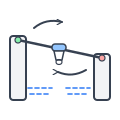
Tie string high-to-low between two points and slide the straw carrier on before final knotting.
Launch Missions
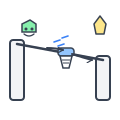
Load a message and release from the higher side, then tweak slope and tension for faster runs.
What You’ll Create
You will build a mini zipline delivery system that carries tiny messages and toy cargo from one “mountain base” to another. It feels like a secret rescue mission where engineering choices actually change performance! 🚚💨
Have fun!
- 🦕 Deliver a tiny Toy Dinosaur passenger and build a rescue storyline.
- 🏁 Race two different carrier designs and compare travel times.
- 📦 Add challenge rounds: fragile package, heavy package, or exact landing zone.
- 🔁 Re-route the line through different rooms for a longer mission map.
Why It’s Amazing
- Physics in Action: Kids experience gravity, friction, and slope by seeing speed change instantly. ⚙️
- Design Iteration: Small tweaks (line angle, pouch size, weight) teach test-and-improve habits. 🔁
- Problem Solving: When the carrier sticks, children diagnose and fix real constraints. 🧩
- Communication Skills: Mission messages turn engineering play into collaborative storytelling. 💬
Pro Tips
For ages 3-5: Let them launch and receive while an adult builds the carrier and line setup.
For ages 5-8: Have them predict which change will make it faster before each test.
For ages 8-12: Track distance and time to calculate average speed, then optimise for efficiency.