Indoor activity
Sponge Sailboat Regatta
Build colourful mini sailboats from kitchen sponges and toothpick masts, then race them across a basin of water by blowing!
Materials
- Kitchen Sponge
- Markers optional
- Paper
- Scissors
- Tape
- Toothpicks
Illustrated Steps
Cut the Sponge Hull
Trim one end of a kitchen sponge into a pointed bow shape by cutting diagonal corners, leaving the other end flat as the stern.

Make the Paper Sail
Cut a paper rectangle, decorate it, and poke two small holes — one near the top and one near the bottom — for threading the mast.

Assemble the Mast and Sail
Thread a toothpick through both holes so the paper bows into a curved sail, then push the toothpick into the centre of the sponge hull.

Race Your Fleet
Float the boats on a basin of water and blow behind the sails to race them across. The steadiest puff wins!
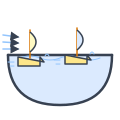
What You’ll Create
You’ll build a fleet of mini sailboats from kitchen sponges, toothpick masts, and paper sails! ⛵ Each boat floats perfectly on water thanks to the sponge hull, and the paper sail catches your breath to zoom across a washing-up bowl or bathtub. Decorate each sail with colours or patterns, then challenge your family to a blowing race!
Have fun!
- 🏴☠️ Make pirate flags with skull-and-crossbone drawings on the sails
- 🌊 Add a few drops of food colouring to the water for a coloured ocean
- 📏 Measure whose boat travels the farthest with a single big puff
- 🪶 Try fanning the sails with a piece of cardboard instead of blowing
Why It’s Amazing
- Buoyancy Basics: Children discover why sponges float (trapped air pockets) and observe how weight distribution affects stability on water.
- Wind & Force: Blowing on sails demonstrates how wind energy converts to forward motion — the same principle behind real sailing.
- Fine Motor Skills: Cutting sponge shapes, threading toothpicks through paper holes, and assembling small parts all develop hand-eye coordination.
- Design Thinking: Experimenting with sail size, hull shape, and mast position teaches iterative problem-solving.
Pro Tips
For ages 3–5: Pre-cut the sponge hull and pre-poke the sail holes. Let them decorate the sail and push the toothpick in with help. Use a shallow baking tray so boats don’t drift out of reach.
For ages 5–8: Let them do all cutting themselves with child-safe scissors. Encourage experimenting with different sail sizes to see which catches more wind.
For ages 8–12: Challenge them to add a keel (a paper clip pushed into the bottom of the sponge) for stability, or build a catamaran from two sponge halves joined with toothpicks.