Indoor activity
Spaghetti & Marshmallow Tower Challenge
Use only dry spaghetti sticks and marshmallows to engineer the tallest freestanding tower you can build — then try to beat your record!
Materials
- Marshmallows
- Ruler
- Uncooked Spaghetti
Illustrated Steps
Set Up Your Building Site
Tip out 20 spaghetti sticks and 20 marshmallows onto a flat table. Keep your ruler nearby — you'll measure your finished tower at the end. Clear plenty of space so your tower has room to sway!

Build a Strong Base
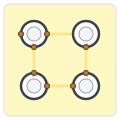
Connect four marshmallows in a square by pushing a spaghetti stick between each pair. Aim for a square about 8–10 cm wide. A wide base is the secret to a tall tower!
Stack Upward
Place a marshmallow on top of each base corner. Push spaghetti sticks between top-corner marshmallows to form a second layer. Keep repeating to reach the ceiling!

Measure and Record
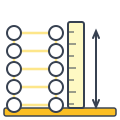
Gently let go. Does it stand? Measure the height with your ruler and write it down. Then build a second tower — what would you do differently this time?
What You’ll Create
You’ll engineer the tallest freestanding tower possible using nothing but dry spaghetti sticks and marshmallows! 🏗️ This classic STEM challenge lets you discover what shapes and structures are really strongest. Can your tower beat your family record? Every collapse teaches you something new — that’s real engineering! 🎉
Have fun!
- 🏆 Challenge a family member to build their own tower at the same time — whose is tallest?
- ⏱️ Set a 10-minute time limit and see how high you can get before the clock runs out.
- 🌉 Try engineering a bridge that spans two stacks of books — can it hold a small toy car on top?
- 🔺 Experiment with triangles: do triangular cross-sections make the tower stronger than squares?
Why It’s Amazing
- Engineering Thinking: Planning a stable structure introduces load paths, triangulation, and structural integrity — the same concepts real engineers use every day. 🏗️
- Maths Skills: Counting materials, measuring height, and comparing results builds number sense and practical measurement. 📏
- Growth Mindset: Every collapse is valuable data! Children practise iterating and improving rather than giving up. 💪
- Teamwork: Collaborating on a build means negotiating ideas, dividing tasks, and celebrating shared wins. 🤝
Pro Tips
For ages 6–8: Pre-connect a square base for them and let them focus on stacking upwards. Celebrate every 10 cm milestone to keep motivation high!
For ages 8–12: Add engineering constraints — the tower must support a coin on top, or span a 15 cm gap. Challenge them to research which geometric shapes are strongest (hint: triangles!).
Slightly stale marshmallows (a day or two old) grip the spaghetti better than fresh ones. If the spaghetti snaps too easily, let it warm to room temperature first.