Indoor activity
Shaving Cream Marble Paper
Swirl food colouring through a tray of shaving cream, press paper on top, then scrape to reveal stunning marble patterns — no two are ever the same!
Materials
- Baking Tray
- Food Colouring
- Paper
- Pen
- Ruler
- Shaving Cream
Illustrated Steps
Spread the Cream
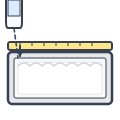
Squeeze a generous layer of shaving cream into the baking tray — about 1–2 cm deep. Use a ruler or piece of card to spread it flat and level across the whole tray, like icing a cake.
Add Colour Swirls
Drop 3–4 drops of food colouring in different spots across the cream using two or three colours. Drag the tip of a pen through the cream in long S-curves to swirl the colours. Stop after 4–6 strokes!

Press the Paper
Lay a sheet of paper face-down onto the cream and press gently with flat hands to make full, even contact. Hold for 30 seconds without rubbing or sliding — the cream needs time to transfer its pattern.

Reveal the Pattern
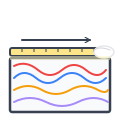
Peel the paper back slowly and place it face-up on newspaper. Hold the ruler flat at one edge and drag it firmly across in one smooth stroke to scrape all the cream off — your marble pattern is revealed!
What You’ll Create
You’ll use shaving cream as a magical canvas to create beautiful marble-effect paper! 🌊 Swirl colours through the foam, press your paper on top, then scrape away the cream to reveal a breathtaking marbled pattern underneath. It looks like something an artist spent hours painting — but it takes just 10 minutes!
Have fun!
- 🎨 Try warm colours (red, orange, yellow) in one batch and cool colours (blue, green, purple) in another.
- 🌀 Experiment with different swirl patterns — circular, zigzag, or concentric rings.
- 📚 Use dried marble paper to make beautiful book covers or stationery.
- 🖼️ Cut your marble paper into shapes and mount on black card for an instant gallery wall.
Why It’s Amazing
- Science of Mixing: Food colouring and shaving cream have different viscosities — this is why they swirl without immediately blending. Children are experimenting with fluid dynamics! 🔬
- Artistic Technique: Marbling is a centuries-old art form used in bookbinding and stationery — children connect to a real craft tradition. 🎨
- Prediction & Outcome: The final pattern is always a surprise, encouraging curiosity and the joy of unexpected results. 🌟
- Fine Motor Skills: Controlled swirling and pressing develops coordination and purposeful movement. ✋
Pro Tips
For ages 3–5: Do the swirling yourself and let them do the pressing and scraping — those are the most satisfying steps! Use only two bold colours.
For ages 6–9: Let them take full ownership of every step. Encourage experimenting: what if you use five colours? What if you swirl in circles instead of curves?
For ages 9–12: Research Turkish Ebru paper marbling — the traditional version uses watercolours floating on a thick carrageenan solution. Can they recreate it with household materials?