Indoor activity
Secret Code Wheel
Build a spinning cipher wheel from paper and use it to encode top-secret messages that only someone with the matching wheel can decode!
Materials
- Paper
- Paper Clips
- Pen
- Ruler
- Scissors
Illustrated Steps
Cut Two Circles
Draw two circles on paper — 12 cm and 9 cm across — and cut them out carefully with scissors.

Divide Into 26 Sections
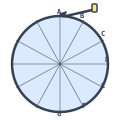
Fold each circle to create 26 equal wedge sections. Write one letter A–Z in each wedge, clockwise around the edge of both circles.
Attach the Wheels
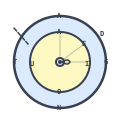
Centre the small circle on the large one. Push a pen tip through both centres, then thread a paper clip through and splay the arms to pin them together.
Set Your Secret Key
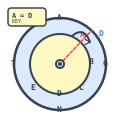
Rotate the inner wheel so that A lines up with your chosen outer letter (e.g. D). This offset is your code key — note it down and keep it secret.
Write and Decode Messages
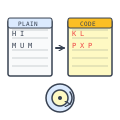
To encode: swap each letter via the inner wheel to the outer. To decode: reverse it. Pass your coded message and key to a friend to try!
What You’ll Create
Design and build your very own cipher wheel — a spinning code machine used by spies and secret agents for hundreds of years! 🕵️ Your wheel encodes any message into unreadable gibberish that only someone with a matching wheel can decode. Make two wheels and swap secret messages with a friend!
Have fun!
- 🕵️ Write a coded birthday message or secret party invitation.
- 🔐 Try to intercept and crack each other’s messages without knowing the key — work through all 26 possible keys!
- 📜 Research the Caesar Cipher — this is exactly what Julius Caesar used to send messages to his generals!
- 🖊️ Try changing the code key every day for a week and see if your friend keeps up.
Why It’s Amazing
- Cryptography Skills: Children learn the fundamentals of substitution ciphers — the foundation of modern digital encryption and computer security. 🔐
- Mathematical Thinking: Creating equal sections, understanding circular sequences, and mapping one alphabet to another builds strong abstract reasoning. 📐
- Reading and Writing: Encoding and decoding messages gives excellent, highly motivated practice in letter recognition and focused reading. 📖
- Engineering Mindset: Building a functional device from a design brief — and fixing it if it wobbles — mirrors real engineering practice. ⚙️
Pro Tips
For ages 8–9: Use a key of A=D — the classic ROT-3 Caesar Cipher — and give them a short encoded message to decode as a first challenge before they start building.
For ages 10–11: Investigate the Vigenère cipher — a more complex code that uses a keyword rather than a single number. Can they upgrade their wheel to handle it?
For ages 11–12: Explore frequency analysis: the letter E is the most common in English. If they intercept a coded message, can they count letter frequencies to crack the key without being told it? 🔬