Indoor activity
Salt Crystal Garden
Grow glittering salt crystals overnight! Dissolve huge amounts of salt in hot water, dangle strings in the solution, and wake up to sparkling crystal clusters.
Materials
- Food Colouring optional
- Magnifying Glass optional
- Ruler
- Salt
- Scissors
- Small Containers
- Spoon
- String
Illustrated Steps
Prepare Your Strings
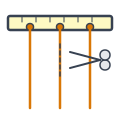
Cut 3–4 pieces of string, each about 20 cm long, using scissors. Tie one end of each piece to the ruler, spacing them evenly so they hang straight down.
Make the Salt Solution
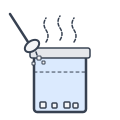
Ask a grown-up to fill each container with very hot tap water. Stir in salt, one teaspoon at a time, until no more dissolves — this is your supersaturated solution!
Add Your Colour
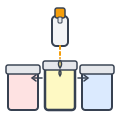
Squeeze 3–4 drops of food colouring into each container and stir until mixed. Use a different colour per container to grow a rainbow of crystals!
Set Up the Crystal Growers
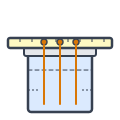
Rest the ruler across the top of each container so the strings hang into the solution. Strings must be fully submerged but not touch the sides or bottom.
Wait for the Magic
Leave completely still for 12–24 hours. Use your magnifying glass to inspect the tiny crystal shapes growing on the strings — they get bigger every hour!

What You’ll Create
You and your child will grow REAL crystals right in your kitchen! 🔮✨ By dissolving as much salt as possible into hot water, you create a “supersaturated” solution — water that is absolutely packed with salt molecules. As the water cools and slowly evaporates, the salt has nowhere to go except to arrange itself into beautiful geometric crystals on your string. The result is a sparkling crystal garden that grows overnight like magic!
Have fun!
- 🌈 Set up three containers in red, blue, and yellow — compare which colour grows the most crystals!
- 📏 Measure your crystals each morning and record their growth in a notebook.
- 🔬 Use the magnifying glass to sketch the crystal shapes — table salt crystals are always perfect tiny cubes!
- 🎁 Once fully grown, carefully lift the ruler out and hang your crystal strings in a sunny window as sparkling decorations.
- 💡 Try the same experiment with sugar instead of salt — do sugar crystals look different?
Why It’s Amazing
- Chemistry in Action: Children witness supersaturation and crystallisation — real chemistry that turns an invisible process into something they can see and touch! 🔬
- Scientific Method: Measuring and recording crystal growth each day practises observation, measurement, and data recording — key science skills. 📊
- Patience and Perseverance: Waiting for crystals to form teaches children that some spectacular things take time. The payoff is worth it! ⏳
- Vocabulary Building: Words like “supersaturated”, “crystallisation”, and “evaporation” become genuinely meaningful through direct hands-on experience. 📚
Pro Tips
For ages 5–8: Pre-measure the salt teaspoons and let children do all the stirring. Count how many spoonfuls it takes before the salt stops dissolving — usually 8–10 per cup of hot water!
For ages 8–12: Challenge them to explain WHY the crystals form. Introduce the concept of a crystal lattice — table salt molecules always arrange into cube shapes, which is why every grain of table salt is a tiny cube.
⚠️ Supervision note: The hot water step requires adult involvement for all ages. Younger children (ages 5–6) may also need help with the scissors.