Indoor activity
Rubber Band Car
Build a simple car from a cardboard box with straw axles and cardboard wheels, then power it with a rubber band motor to zoom across the floor!
Materials
- Cardboard Boxes
- Rubber Bands
- Scissors
- Straws
- Tape
Illustrated Steps
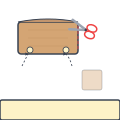
Build the Car Body
Trim a small cardboard box into a car shape. Poke matching holes on each side for axles.
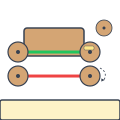
Add Wheels and Axles
Slide straws through the holes as axles. Attach cardboard circle wheels and secure with tape.
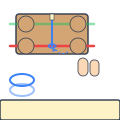
Create the Rubber Band Motor
Loop a rubber band around the rear axle and hook it to the car body. Wind to store energy!
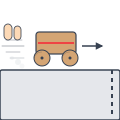
Race Your Car
Wind the rear wheels backward, place on a smooth floor, and let go — zoom!
What You’ll Create
Start your engines! 🏎️ Your little engineers will build a working car from a small cardboard box, using straws for axles and cardboard circles for wheels, then power it with a rubber band motor that makes it actually zoom across the floor! Wind up the rubber band, place the car down, and watch it race away. It’s real engineering with real results!
Have fun!
- 🏆 Build two cars and race them against each other!
- 📏 Measure how far your car travels with 5, 10, and 15 winds — make a graph!
- 🎨 Decorate your car with markers, stickers, and racing stripes!
- 🔬 Experiment with bigger wheels vs. smaller wheels — which goes faster?
Why It’s Amazing
Engineering Principles: Children learn about axles, wheels, and mechanical energy storage — real engineering concepts applied hands-on. ⚙️
Energy and Motion: The rubber band demonstrates potential energy converting to kinetic energy — core physics made tangible and exciting. 🔬
Problem-Solving: Getting the car to actually work requires troubleshooting — wheel alignment, friction, rubber band tension — real engineering challenges. 🧠
Scientific Method: Testing different variables (number of winds, wheel size, surface type) introduces experimental thinking naturally. 📊
Pro Tips
For ages 4–6: An adult should handle the cutting and hole-poking. Focus on assembling the wheels and the exciting moment of winding and releasing. Don’t worry if the car wobbles — the magic is in making something move on its own!
For ages 6–9: Let them build most of it themselves with supervision for cutting. Encourage them to troubleshoot — if the car doesn’t move, why not? Is it too heavy? Are the wheels dragging? Introduce the idea of reducing friction.
For ages 9–12: Challenge them to optimise for maximum distance. Test multiple rubber bands, different wheel sizes, lighter body materials. Keep a data table of results. Discuss why racing cars are shaped the way they are (aerodynamics).
Secret Pro Move: For the smoothest-rolling wheels, use plastic bottle caps instead of cardboard circles — they’re perfectly round, lightweight, and spin beautifully on the straw axles. Just poke a hole through the centre of each cap! 🎯