Indoor activity
Popsicle Stick Marble Maze
Glue popsicle sticks onto cardboard to build a twisting maze, then tilt the board to guide a marble from start to finish!
Materials
- Cardboard Boxes
- Marbles
- Markers
- Popsicle Sticks
- PVA Glue
- Scissors
Illustrated Steps
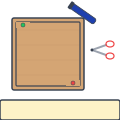
Prepare the Base
Cut cardboard into a square and mark the START and FINISH openings with a marker.
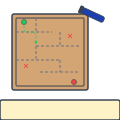
Design the Maze Path
Sketch maze corridors on the cardboard with dead ends and at least one route through.
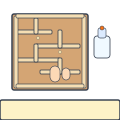
Glue the Walls
Glue popsicle sticks along the drawn lines to create maze walls. Let dry completely.
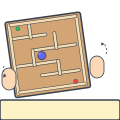
Play the Maze
Place a marble at START, tilt the board to guide it through the corridors to FINISH!
What You’ll Create
A tilting tabletop maze! 🏗️ Your little engineers will glue popsicle sticks onto a cardboard base to create walls and corridors, then challenge themselves (and everyone else!) to guide a marble from start to finish by tilting the board. Design dead ends, tricky turns, and secret shortcuts — every maze is different!
Have fun!
- ⏱️ Use a stopwatch and race against friends — fastest marble to the finish wins!
- 🎨 Decorate the walls and base with markers before playing — theme it as a castle, space station, or jungle!
- 🔀 Build a maze with multiple exits — only one leads to the real finish!
- 📐 Try building a double-decker maze by stacking two cardboard layers with holes between them!
Why It’s Amazing
Spatial Planning: Designing a maze that actually works requires thinking about paths, dead ends, and connectivity — real problem-solving! 🧠
Fine Motor Precision: Cutting sticks to length and gluing them along drawn lines builds precise hand-eye coordination. ✋
Physics in Action: Tilting the board to control the marble teaches about gravity, angles, and momentum through play. ⚡
Iterative Design: When a path is too wide or a wall too short, kids learn to test, adjust, and improve — the engineering design cycle! 🔬
Pro Tips
For ages 3–5: Pre-cut the popsicle sticks and draw the maze lines. Let them apply glue and press sticks down. Keep the maze simple with just 2–3 turns and no dead ends.
For ages 5–8: Let them design their own maze with 4–6 turns and 2–3 dead ends. Show them how to snap sticks to the right length. They’ll love timing each other!
For ages 8–12: Challenge them to build complex mazes with multiple dead ends, narrow passages, and even moving gates (a loose stick that pivots). Add a scoring system — fewer tilts = higher score. Try building with a friend and swapping mazes to solve!
Secret Pro Move: Glue a thin border of popsicle sticks all the way around the edge of the cardboard (leaving only the start and finish gaps) — this stops the marble rolling off the sides and makes the maze feel like a proper game board! 🎯