Indoor activity
Paper Weaving Rainbow
Weave colourful paper strips into a rainbow placemat or wall decoration — a satisfying craft that builds fine motor skills and pattern sense with zero special materials!
Materials
- Colouring Pencils
- Markers optional
- Paper
- Scissors
- Tape
Illustrated Steps
Fold and Cut the Loom
Fold a sheet of paper in half lengthways and cut slits from the fold toward the open edge, stopping 2 cm short. Unfold — this is your loom.

Cut and Colour Strips
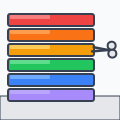
Cut more sheets into long strips about 2 cm wide and colour each one a bold rainbow hue: red, orange, yellow, green, blue, violet.
Weave Over and Under
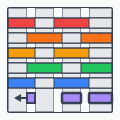
Thread the first strip over slit one, under slit two, over slit three. The next strip starts under — alternating each row creates the woven pattern.
Secure and Display
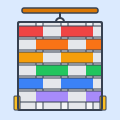
Once all slits are filled, fold overhanging ends to the back and tape them down. Punch a hole at the top and hang it as wall art.
What You’ll Create
Transform strips of colourful paper into a gorgeous woven rainbow placemat or wall decoration! 🌈✂️ Your child will weave strips over and under each other to create a magical interlocking pattern — it looks impressively complex, but the technique is wonderfully simple once you get the rhythm.
Have fun!
- 🌈 Try a gradient — light colours on one side fading to dark on the other
- 🎁 Weave a mini version to make a bookmark or gift tag
- 🔢 Count the over-under pattern together: “over 1, under 2…”
- ✂️ Cut strips in different widths for a chunky vs. fine weave effect
- 🏅 Challenge: can you weave a pattern that spells your initial?
Why It’s Amazing
- Fine Motor Skills: The precise over-under threading massively strengthens hand-eye coordination and finger dexterity — exactly what growing hands need. 🖐️
- Pattern Recognition: Children must apply the alternating rule consistently, building early maths thinking and logical sequencing. 🧮
- Focus and Perseverance: This quiet, absorbing activity rewards concentration. Finishing the full mat delivers a huge sense of accomplishment. 🏆
- Colour Theory: Choosing and combining hues develops aesthetic awareness and creative decision-making. 🎨
Pro Tips
For ages 5–6: Use wider strips (3–4 cm) and wider slits so threading is easier to manage. A grown-up can hold the loom flat while they thread.
For ages 7–8: Challenge them to plan a repeating colour sequence before starting — red, blue, yellow, red, blue, yellow — and stick to it.
For ages 8+: Introduce diagonal weaving, or graduate to a simple cardboard loom with yarn for a proper textile result.