Indoor activity
Paper Towel Tie-Dye
Fold paper towels, dip the corners in vivid food-colouring water, then unfold to reveal a magical burst of colour — every one is a unique surprise!
Materials
- Food Colouring
- Paper Towels
- Small Containers
Illustrated Steps
Fold the Paper Towel
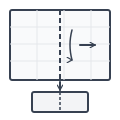
Lay a paper towel flat. Fold it in half left to right, then in half again top to bottom — you now have a small square, four layers thick. Fold that square diagonally corner to corner to make a triangle.
Dip the Corners
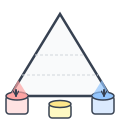
Mix 4–5 drops of food colouring into a small container of water — one colour per container. Dip each corner of the folded triangle into a different colour for 2–3 seconds so the dye soaks about 1 cm in.
Unfold Carefully
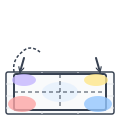
Place the dyed towel on newspaper. Starting from the last fold, gently peel back each layer in reverse order until fully flat. Move slowly — wet paper tears easily! Watch the pattern grow as you unfold.
Dry and Display
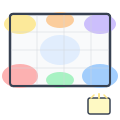
Leave the towel flat and undisturbed to dry for 30–60 minutes. Once dry, the colours are permanent! Hold it up to a window for a stained-glass effect, or use it as unique gift wrapping.
What You’ll Create
You’ll turn ordinary paper towels into vibrant works of art! 🌈 Fold, dip, and unfold to reveal a brilliant explosion of colour — every single design is completely unique to you. These beautiful creations make perfect wrapping paper, window decorations, or cards for someone special.
Have fun!
- 🌈 Make five designs in different colour combinations and hang them in a row like bunting.
- ⭐ Try an accordion (fan) fold instead of quarters — it makes a striped or sunburst pattern!
- 🎁 Wrap a small gift with your dried tie-dye towel — the wrapping IS the present.
- 💧 Experiment with dip time: holding longer absorbs more colour and creates bolder bursts.
Why It’s Amazing
- Colour Theory: Watching how different dyes bleed and blend teaches children about primary, secondary, and complementary colours in a vivid, hands-on way. 🎨
- Prediction & Discovery: Ask what pattern they think will appear before unfolding — then compare prediction to reality. That’s the scientific method at work! 🔬
- Fine Motor Skills: Precise folding of a flat sheet and careful unfolding of wet paper develops hand control and patience. ✋
- Creative Expression: No two designs are ever identical, giving every child a completely unique piece of art to be proud of. 🌟
Pro Tips
For ages 3–5: Pre-fold the towels and let them focus entirely on the fun dipping step. Limit to two colours to keep results clear and bright without muddy mixing.
For ages 6–8: Let them design their own folding pattern before dipping. Challenge them to predict what shape the colour burst will make based on which corner they dip.
For ages 8–12: Introduce the concept of symmetry — a diagonally-folded towel produces a reflected mirror pattern. Can they design a fold that creates a radial (equal in all directions) pattern?