Indoor activity
Paper Plate Peacock
Fan colourful paper feathers behind a painted paper plate body to create a dazzling peacock with googly eyes and a paper beak!
Materials
- Flat Paintbrush
- Googly Eyes
- Paper
- Paper Plates
- Poster Paint
- PVA Glue
- Scissors
Illustrated Steps
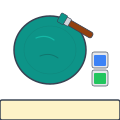
Paint the Body
Paint a paper plate blue-green for the peacock body. Let dry completely.
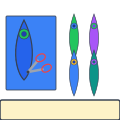
Make the Tail Feathers
Cut long teardrop shapes from colourful paper and add circle eye-spots near each tip.
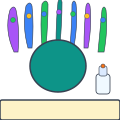
Attach the Tail
Fan feathers evenly behind the top of the plate and glue to the back.
Add Face and Feet
Stick on googly eyes, a folded diamond beak, and orange paper feet!
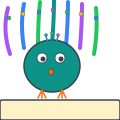
What You’ll Create
A bird fit for a palace! 🦚 Your little ornithologists will transform a paper plate into a stunning peacock by painting it a rich blue-green, then fanning out a spectacular tail of colourful paper feathers decorated with eye-spots behind the body. Add googly eyes, a paper beak, and little feet — a show-stopping display piece!
Have fun!
- ✨ Add glitter to the feathers for extra sparkle — real peacock feathers are iridescent!
- 🌈 Make each feather a different colour for a rainbow peacock!
- 🪶 Add a tiny crown of small feathers on the head — real peacocks have head crests!
- 📖 Learn about peafowl — only males have the big tail display, and they use it to attract mates!
Why It’s Amazing
Biology Discovery: Peacocks are a perfect gateway to learning about sexual selection, bird displays, and why animals evolved bright colours. 🦚
Symmetry and Pattern: Arranging feathers in an even fan and creating repeated eye-spots teaches pattern recognition and bilateral symmetry. 📐
Colour Theory: Mixing blues and greens, choosing complementary eye-spot colours, and creating an overall colour scheme builds artistic confidence. 🎨
Fine Motor Skills: Cutting elongated feather shapes, gluing small circles for eye-spots, and precise assembly all build dexterity. ✋
Pro Tips
For ages 3–5: Pre-cut the feathers and eye-spot circles. Let them paint the plate and stick feathers and eyes on. The fan arrangement is so satisfying — they’ll want to make more!
For ages 5–8: Let them cut their own feathers and decorate each one. Show them how to arrange feathers in an even fan before gluing. Challenge them to make the eye-spots look realistic.
For ages 8–12: Research real peacock feather patterns — the eye-spots have concentric rings of different colours. Recreate this detail. Try curling feather edges with scissors for 3D effect. Compare Indian blue peafowl with green peafowl and create both species.
Secret Pro Move: Before gluing the feathers to the back, slightly curve each one by pulling it gently over a table edge (like curling ribbon) — this makes the feathers arc outward beautifully and gives the tail real depth! 🎯