Indoor activity
Paper Plate Owl
Paint a paper plate in autumn colours, fold down flaps for wings, add big circle eyes, a triangle beak, and feathery details — twit twoo!
Materials
- Flat Paintbrush
- Markers
- Paper
- Paper Plates
- Poster Paint
- PVA Glue
- Scissors
Illustrated Steps
Paint the Plate
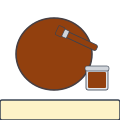
Paint the bottom of a paper plate in warm brown or autumn colours. Let it dry.
Create the Wings
Fold two opposite sides of the plate inward to make wing flaps.

Make the Face
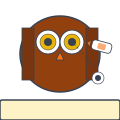
Cut big white circle eyes, draw pupils, and add a triangle beak between them.
Add Feather Details
Draw feathery scallop patterns, add ear tufts, eyebrows, and little feet!
What You’ll Create
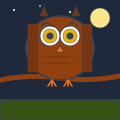
Twit twoo! 🦉 Your little night-owls will create a wide-eyed owl from a paper plate. Paint it in warm woodland colours, fold down two flaps at the sides for wings, cut out big round eyes, add a triangle beak, and decorate with feathery patterns using markers. It’s a charming woodland creature that looks like it just flew in from the forest!
Have fun!
- 🌲 Create a woodland scene with a tree branch for the owl to sit on!
- 🌙 Make it a night scene — dark blue background with a moon and stars!
- 📖 Learn about different owl species — barn owls, snowy owls, eagle owls!
- 🔊 Listen to real owl calls online — can you make the twit-twoo sound?
Why It’s Amazing
Nature Education: A gateway to learning about owls — nocturnal animals, silent flight, incredible hearing, and their role in the food chain. 🌿
Pattern Skills: Drawing feather patterns introduces repeating decorative patterns — scallops, U-shapes, and layered textures develop artistic technique. 🎨
Symmetry Practice: Folding equal wings, placing matching eyes, and creating balanced feather patterns all reinforce bilateral symmetry. 🔢
3D Thinking: Folding a flat plate to create wing flaps teaches basic 3D construction from 2D materials. 🏗️
Pro Tips
For ages 3–5: Pre-fold the wings and cut the eye circles. Let them paint the plate and glue on the face pieces. The big round eyes are the star feature!
For ages 5–8: Let them fold their own wings and cut eye circles. Show them the scallop pattern for feathers. Challenge them to make the owl look wise and serious!
For ages 8–12: Research real owl species and replicate specific markings — the barn owl’s heart-shaped face, the snowy owl’s white feathers with dark bars. Add 3D ear tufts and detailed feather textures.
Secret Pro Move: Use two slightly different sizes of circle for the eyes — a larger outer white circle and a slightly smaller inner yellow circle before the black pupil. This layered eye technique makes the owl look dramatically more realistic and alive! 🎯