Outdoor activity
Paper Plate Frisbee
Cut out the centres of two paper plates, tape the rims together to make a flying frisbee ring, then decorate and throw!
Materials
- Markers optional
- Paper Plates
- Scissors
- Stickers optional
- Tape
Illustrated Steps
Cut Out the Centres
Cut the flat centre out of two paper plates, leaving just the raised rim rings.

Tape the Rings Together
Stack the two rims bottom-to-bottom and wrap tape all the way around to join them firmly.

Decorate Your Frisbee
Draw bold patterns with markers — spirals, stars, flames. The designs blur when it spins!

Throw and Play!
Head outside, flick your wrist to throw, and see how far it flies. Set up targets for points!
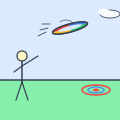
What You’ll Create
Ultimate frisbee — homemade edition! 🥏 Your little athletes will transform two paper plates into a surprisingly aerodynamic flying ring by cutting out the centres and taping the rims together. Decorate it with bold markers and stickers, then head outside to throw, catch, and see how far it can fly!
Have fun!
- 🎯 Set up a frisbee golf course with targets around the garden!
- 📏 Have a distance competition — mark each throw with a stick!
- 🐕 Play frisbee catch — how many catches in a row without dropping?
- 🌀 Try throwing with different spins — backhand, forehand, underarm!
Why It’s Amazing
Aerodynamics: Children discover how spinning discs create lift and stability — real physics that they can feel in their hands! ✈️
Gross Motor Skills: Throwing a frisbee develops arm strength, wrist control, and full-body coordination. 💪
Iteration & Improvement: If the first frisbee doesn’t fly well, children can adjust (more tape, different weight) and try again — engineering thinking! 🔧
Outdoor Active Play: Getting outside to run, throw, and catch provides fantastic exercise disguised as pure fun. 🏃
Pro Tips
For ages 3–5: Make the frisbee for them and focus on decorating and gentle throwing. Stand close together and practice underhand tosses. Celebrate every catch!
For ages 5–8: Let them help with cutting and taping. Teach them the wrist-flick technique. Have them experiment: does the frisbee fly better with more or less tape?
For ages 8–12: Challenge them to design the optimal frisbee — what rim width, weight, and decoration pattern flies best? Set up competitions with specific rules. Introduce the concept of aerodynamics and why spinning creates stability.
Secret Pro Move: Lightly fold the rim edges upward by about 5 mm all the way around — this creates an airfoil shape that dramatically improves lift and flight distance! 🚀