Indoor activity
Paper Plate Clock
Build a working clock with movable hands from a paper plate — then play time-telling games to learn hours and minutes!
Materials
- Markers
- Paper
- Paper Clips
- Paper Plates
- Stickers optional
Illustrated Steps
Create the Clock Face
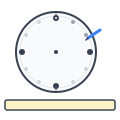
Write numbers 1-12 around a paper plate rim with markers. Start with 12, 3, 6, 9, then fill in the rest.
Make the Clock Hands
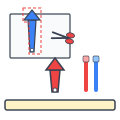
Cut two arrow shapes from paper — a long minute hand and short hour hand. Colour them differently.
Attach the Hands
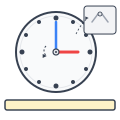
Push a paper clip fastener through both hands and the centre hole. Bend on the back so hands spin freely.
Play Time-Telling Games!
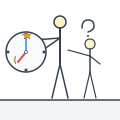
Call out times and race to set them. Add stickers at special times like wake-up, lunch, and bedtime!
What You’ll Create
What time is it? Time to MAKE a clock! ⏰ Your little timekeepers will transform a humble paper plate into a fully functioning clock with movable hands. Write the numbers, attach spinning hands with a paper clip fastener, and then play brilliant time-telling games together. It’s the perfect blend of crafting and early maths!
Have fun!
- 🏃 Play “What’s the Time, Mr Wolf?” and set the clock for each answer!
- 📋 Make a daily schedule using your clock — set each activity time!
- 🔔 Set an “alarm” on your clock and when the real time matches, do a silly dance!
- 🧩 Draw the same time on paper that your partner sets on the clock!
Why It’s Amazing
Numeracy & Time: Children learn to read analogue clocks — a skill that builds understanding of fractions, counting by fives, and number positioning. 🔢
Sequencing: Connecting times to daily routines teaches children about the structure and sequence of their day. 📅
Fine Motor Skills: Writing small numbers, cutting precise shapes, and manipulating the fastener all develop hand control. ✋
Practical Life Skills: Telling time is a real-world skill children will use every day — this gives them ownership over learning it through play. ⏰
Pro Tips
For ages 3–5: Focus on the hours only (“the short hand points to…”). Pre-write the numbers in light pencil and let them trace over in marker. Use the clock for routine times: “This is breakfast time!”
For ages 5–8: Introduce “o’clock” and “half past.” Add minute numbers (5, 10, 15…) in a smaller ring inside the hour numbers. Play games with increasingly specific times.
For ages 8–12: Add minute markings and practice reading exact times like 7:43. Challenge them to calculate elapsed time: “If we start at 2:15 and play for 45 minutes, what time do we finish?” Make a second clock and practice time zone differences.
Secret Pro Move: Make TWO clocks — one showing the current time (keep it updated through the day) and one for practice. Comparing them teaches children to check their work against reality! 🕐