Indoor activity
Paper Mosaic Art
Tear coloured tissue paper into tiny mosaic tiles and arrange them into a vibrant picture — just like ancient Romans did! Glows beautifully when held to the light.
Materials
- Colouring Pencils
- Flat Paintbrush
- Paper
- PVA Glue
- Tissue Paper
Illustrated Steps
Sketch Your Design
Lightly sketch a bold, simple design on plain paper using a colouring pencil. Think sun, fish, or geometric shapes — clear outlines divided into colour zones work best for mosaics.

Tear the Tiles
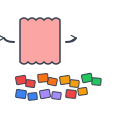
Tear tissue paper into small irregular pieces about 1–2 cm across and sort by colour into piles. Uneven edges are good — they look like real ancient stone tiles!
Glue the Tiles
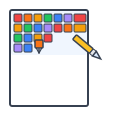
Brush diluted PVA glue onto one small section at a time. Press tissue tiles onto the glue leaving a tiny gap between each piece for the grout line. Work section by section.
Seal the Mosaic
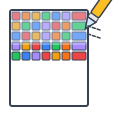
Brush a final even layer of diluted PVA glue over the whole finished mosaic. This seals tiles and adds a glossy finish. Leave flat to dry 30 minutes, then hold to the light!
What You’ll Create
You’ll create a spectacular piece of mosaic art 🎨 — just like the incredible floor and wall mosaics that decorated ancient Roman buildings! Instead of stone tiles, you’ll use torn pieces of coloured tissue paper as your “tesserae” (the technical word for mosaic tiles). The finished picture glows like stained glass when you hold it to the light — absolutely stunning to display in a window! ✨
Have fun!
- 🏛️ Research ancient Roman or Byzantine mosaics and try to recreate a design you find
- 🌟 Layer two colours of tissue paper on top of each other to mix new colours
- 🖼️ Frame your finished mosaic in a cardboard border and display it in a window
- 👨👩👧 Make a giant group mosaic by assigning one section to each family member
- ✨ Use metallic or sparkly tissue paper for an extra brilliant golden highlight!
Why It’s Amazing
- Art History Connection: Learning the ancient craft of mosaic connects art-making to history, culture, and archaeology. 🏛️
- Colour Theory: Arranging and layering coloured tissue explores how colours interact and create mood and atmosphere. 🎨
- Fine Motor Precision: Placing tiny tiles while maintaining consistent grout lines builds detailed hand control and focus. ✂️
- Planning and Patience: Working methodically section-by-section teaches process-oriented thinking and attention to detail. 📐
Pro Tips
For ages 5–7: Pre-sketch the design for them and let them focus entirely on the tearing and tile-placing. Use larger tiles (2–3 cm) which are much easier to handle with little fingers.
For ages 8–12: Challenge them to sketch and execute their own design from scratch. Introduce the vocabulary: tesserae, grout line, opus vermiculatum (the technique of following a figure’s outline with tiles).
For extra effect: use gold or silver metallic tissue paper for highlights. One gold detail makes the whole mosaic look truly Byzantine! ✨