Indoor activity
Paper Cup Catch Game
Make a catch game from a paper cup and string with a tinfoil ball — toss and catch it in the cup!
Materials
- Aluminium Foil
- Googly Eyes
- Paper Plates
- Scissors
- String
- Tape
Illustrated Steps
Make the Ball
Scrunch tinfoil into a tight, round ball about the size of a large marble.

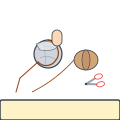
Attach the String
Wrap string around the ball and squeeze more foil over it to lock it in place.
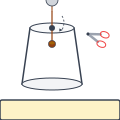
Prepare the Cup
Poke a hole in the cup bottom, thread the string through, and tie a knot inside.
Decorate and Play
Decorate the cup with markers, then toss the ball up and catch it in the cup!

What You’ll Create
A classic cup-and-ball catch game made from kitchen supplies! 🏆 Your little game-makers will attach a tinfoil ball to a paper cup with string, then try to toss the ball up and catch it in the cup. It sounds simple but it’s wonderfully tricky — and incredibly addictive once you get the hang of it!
Have fun!
- 🏅 Hold a tournament — who can get the most catches in 30 seconds?
- 📏 Try different string lengths — shorter is easier, longer is harder!
- 🎯 Make the ball bigger or smaller to change the difficulty!
- 🌟 Add a points system — 1 point for a catch, 3 points for catching it behind your back!
Why It’s Amazing
Hand-Eye Coordination: Tossing and catching the ball trains precise motor control, timing, and spatial awareness. 🎯
Physics in Action: Children discover how string length, ball weight, and wrist flick angle all affect the trajectory — real pendulum physics! 🔬
Persistence and Growth Mindset: This game is hard at first! Learning through repeated attempts builds resilience and the joy of mastering a skill. 💪
Simple Engineering: Constructing a working toy from basic materials shows that fun doesn’t need batteries or screens. 🔧
Pro Tips
For ages 3–5: Use a bigger cup (or cut down a paper cup so the opening is wider) and a shorter string (20 cm). Make the ball bigger too. Celebrate every catch enthusiastically — this is genuinely tricky for little ones!
For ages 5–8: Standard cup and 40 cm string. Show them the wrist-flick technique (swing out, not straight up). Challenge them to beat their personal record. Let them experiment with string length.
For ages 8–12: Make it competitive — timed challenges, trick catches, non-dominant hand only. Try making a double-cup version (two cups on opposite ends of the string with the ball in the middle). Research the history of bilboquet/kendama — this game has been played for hundreds of years worldwide!
Secret Pro Move: Add a small blob of sticky tack inside the bottom of the cup — when the ball lands, the slight stickiness stops it bouncing straight out again, making those first successful catches much more achievable and building confidence! 🎯