Indoor activity
Paper Chain Snake
Cut colourful paper strips, loop them into a chain, and add googly eyes and a forked tongue to make a wiggly, slithery snake!
Materials
- Googly Eyes
- Markers optional
- Paper
- PVA Glue
- Scissors
Illustrated Steps
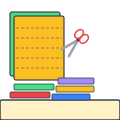
Cut Paper Strips
Cut coloured paper into strips about 2 cm wide and 15 cm long. Make at least 15–20 strips.
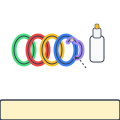
Build the Chain
Loop each strip into a ring, threading it through the previous link before gluing closed.
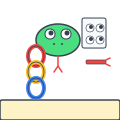
Create the Head
Make a wider, flatter link for the head. Add googly eyes and a forked red paper tongue.
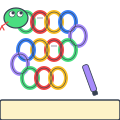
Decorate and Play
Draw scale patterns on the links with markers. Drape, coil, and slither your snake!
What You’ll Create
Ssssssensational! 🐍 Your little crafters will cut strips of colourful paper, loop them into interlocking chain links, and create a magnificent wiggly snake! Add googly eyes and a forked tongue cut from red paper, and you’ve got a slithery friend that can coil around chair legs, hang from door handles, or be worn as a boa constrictor scarf. The longer you make it, the more impressive it gets!
Have fun!
- 📏 Have a competition — who can make the longest snake?
- 🌈 Make a rainbow snake with the colours in spectrum order!
- 📐 Count the links and practise skip counting by 2s or 5s!
- 🐛 Make other creatures too — a caterpillar, a worm, or a centipede!
Why It’s Amazing
Fine Motor Skills: Cutting strips, threading links, and applying glue precisely all develop hand dexterity and coordination. ✋
Pattern Recognition: Choosing and alternating colours introduces children to the concept of repeating patterns — a key early maths skill. 🔢
Sequencing: Building a chain link by link teaches sequential thinking — each step depends on the previous one being complete. 🧠
Measurement Concepts: Cutting strips to similar sizes introduces ideas about length, width, and consistency. 📏
Pro Tips
For ages 3–5: Pre-cut the strips and focus on the looping and gluing. Help thread each strip through the previous link — the concept of “through then around” takes practice. Use a glue stick instead of PVA for faster, less messy assembly.
For ages 5–8: Let them cut their own strips (draw guide lines first). Encourage pattern planning — “What colour comes next?” Challenge them to predict how long their snake will be based on the number of links.
For ages 8–12: Introduce mathematical challenges — if each link is 15 cm and the chain has 20 links, how long is the snake? Try paper weaving through the links for extra texture. Research real snake patterns (diamond python, coral snake) and replicate them.
Secret Pro Move: For extra-sturdy links that survive enthusiastic play, use a stapler instead of glue — one staple per link is faster and stronger. Just make sure the staple ends are tucked inward so they don’t scratch! 📎