Indoor activity
Newspaper Tower Challenge
Roll newspaper sheets into tubes and tape them together to build the tallest freestanding tower you can. How high can you go before it wobbles?
Materials
- Newspaper
- Ruler
- Tape
Illustrated Steps
Roll Your Tubes
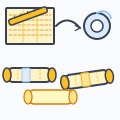
Roll each newspaper sheet tightly around a ruler diagonally, slide the ruler out, and tape the tube closed. Make at least 15.
Sketch Your Design
Draw two tower designs on scrap paper focusing on a wide base tapering upward. Pick your favourite before you start building.

Build the Base
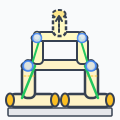
Arrange 3–4 tubes in a triangle or square and tape all joints twice for a firm, stable foundation.

Add Layers
Connect tubes upward and add diagonal bracing between supports to triangulate and strengthen each level.
Measure and Compare
Record your tower's height with a ruler, then rebuild using what you learned to beat your own record.

What You’ll Create
Armed with nothing but a stack of old newspapers and a roll of tape, you’re going to design and build the tallest freestanding tower you possibly can! 🏗️ No glue — just clever engineering and structural thinking. The taller it stands on its own, the better your design! Challenge a sibling or friend to build their own tower at the same time and see whose reaches higher.
Have fun!
- 🏆 Challenge a family member to build their own tower at the same time.
- ⚖️ Test how many books the top of your tower can hold before it collapses.
- 📐 Try a completely different base shape (pentagon, hexagon) and compare heights.
- 🔬 Experiment with tube tightness — does a looser roll change the tower’s strength?
Why It’s Amazing
- Structural Engineering: Children learn the same principles professional engineers use — triangulation, base width, and load distribution. 🔩
- Scientific Method: Building, measuring, and iterating is exactly how real scientists and engineers work. 🔬
- Spatial Reasoning: Sketching before building strengthens 3D visualisation skills essential for maths and science. 📐
- Resilience: When a tower falls, the lesson isn’t failure — it’s data. Rebuilding teaches persistence. 💪
Pro Tips
For ages 8–10: Focus on height as the only goal — it keeps the challenge simple and exciting.
For ages 10–12: Add engineering constraints — the tower must support a full 500 ml water bottle on top, or must be built in under 20 minutes.
Tip: Diagonal bracing (triangles) is the single most effective technique. If kids are stuck, hint that triangles are used in every bridge and skyscraper.