Indoor activity
Marshmallow Catapult
Build a working catapult from straws, a spoon, tape, and rubber bands, then compete to launch marshmallows the farthest — a brilliant STEM challenge that doubles as a tasty snack break!
Materials
- Marshmallows
- Rubber Bands
- Ruler
- Spoon
- Straws
- Tape
Illustrated Steps
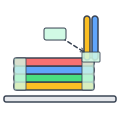
Build the Base
Bundle four straws together and tape the ends tightly. Tape two straws upright at one end as the pivot support. This forms the catapult base.
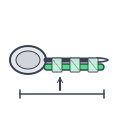
Attach the Arm
Tape a spoon firmly along a single straw so the bowl extends beyond the end. This spoon-straw is your throwing arm.
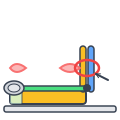
Add the Rubber Band
Loop a rubber band around the two upright straws. Slide the arm under the band near the midpoint so pulling the spoon down creates upward spring tension.
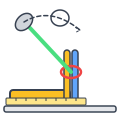
Launch!
Place a marshmallow in the spoon, hold the base down, pull the spoon arm back, and release. Measure the distance and adjust the design to launch farther!
What You’ll Create
Engineer a real working catapult from everyday materials and use it to launch marshmallows across the room! 🏹 The build is simple enough for kids to tackle independently but satisfying enough to keep them tweaking and experimenting — adjusting the arm angle, changing the rubber band tension, and measuring distances. It is classic hands-on STEM with an irresistible reward built in.
Have fun!
- 🎯 Set up targets (cups, hoops, zones) and score points for landing in each one.
- 📏 Keep a score sheet and record your best distance after each tweak.
- ⚙️ Try different arm lengths — does a longer arm throw farther?
- 🏆 Challenge another person to build their own and compete for distance.
Why It’s Amazing
- Physics: Children directly experience potential and kinetic energy — pull back creates stored energy, release converts it to motion. 🔋
- Engineering Design: Build, test, measure, adjust — this is the real engineering loop. Every tweak is an experiment with a result. ⚙️
- Measurement: Comparing distances with a ruler and recording results introduces systematic data collection in a fun context. 📏
- Resilience: When the catapult misfires or launches sideways, that is a data point — not a failure — and figuring out why builds persistence. 💪
Pro Tips
For ages 6–8: Simplify the build — just tape the spoon directly to a single straw and loop a rubber band at the midpoint. Focus on the fun of launching, not precision engineering.
For ages 8–11: Introduce the challenge of a specific target distance. Measure and record three launches, compute the average, and adjust the design to improve it.
For ages 11+: Add multiple rubber bands and measure how tension affects distance. Graph launch distance vs. pull angle for a genuine science experiment. 📊