Indoor activity
DIY Spinning Pinwheel
Cut and fold a sheet of paper into a beautiful spinning pinwheel in just 4 steps — decorate with bold patterns and watch the colours blur as it whirls in the wind!
Materials
- Colouring Pencils
- Paper
- Pen
- Scissors
- Straws
- Tape
Illustrated Steps
Make a Decorated Square
Decorate one side of paper with bold diagonal stripes or spirals. Then cut a perfect square by folding one corner to the opposite edge, creasing, and cutting off the strip below.
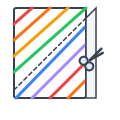
Mark Centre and Draw Diagonals
Fold the square diagonally both ways to create an X crease. Mark a dot 1.5 cm from the centre on each crease — this is your cut-stop mark. Draw lines from each corner to the dots.

Cut and Fold the Flaps
Cut from each corner to the dot. Bring every other flap tip to the centre (skip one, bring one, skip one, bring one). Secure the overlapping tips with a small piece of tape.

Attach the Handle
Push a straw through the centre from front to back. Wrap tape around the straw just behind the pinwheel as a stopper. The pinwheel should spin freely — hold it in the wind!

What You’ll Create
You’ll fold and cut a single sheet of paper into a beautiful spinning pinwheel 🌀 that whirls in the breeze! Decorate it with rainbow swirls or bold diagonal stripes, attach it to a straw handle, and watch the patterns blur into a mesmerising spinning disc of colour. Pure magic powered by wind and geometry! ✨
Have fun!
- 🌬️ Run with your pinwheel — who can make it spin the fastest?
- 🎨 Make several in different sizes and hold a spinning contest
- 🌡️ Test different spots around the house — which is windiest?
- 📏 Does a bigger pinwheel spin at the same speed as a small one?
- 🌈 Try metallic or patterned paper for an extra dazzling effect!
Why It’s Amazing
- Geometry in Action: Creating a perfect square and folding along precise crease lines teaches symmetry and spatial reasoning. 📐
- Physics Discovery: Children experience wind as a force — and discover how blade angle affects spin speed. 🌬️
- Fine Motor Skills: Careful cutting along marked lines and threading a straw strengthens precision and control. ✂️
- Design Thinking: Patterns that look great as a spinning disc differ from static ones — a brilliant visual design challenge! 🎨
Pro Tips
For ages 4–6: Pre-mark all the fold lines and cut-stop dots. Let children do the decorating independently and the cutting with close adult supervision.
For ages 6–8: Let them complete all steps independently. Challenge them to predict which pattern will look coolest when spinning — then test it!
For ages 8–12: Research how wind turbine blade angles are engineered and experiment with different fold angles on the flaps to see which spins most easily.