Indoor activity
DIY Memory Card Game
Cut paper into cards, draw matching pairs of pictures on them, lay face-down, and play the classic memory matching game you made yourself!
Materials
- Markers
- Paper
- Ruler optional
- Scissors
Illustrated Steps
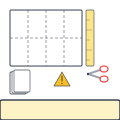
Cut the Cards
Cut paper into 12–20 equal-sized rectangular cards using scissors and a ruler.
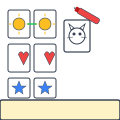
Draw Matching Pairs
Draw bold pictures on each card — every picture needs an exact matching partner!
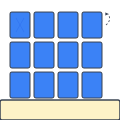
Mix and Lay Out
Shuffle all cards and lay them face-down in neat rows on a flat surface.
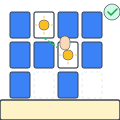
Play the Game
Flip two cards — if they match, keep them! If not, flip back and remember where they were.
What You’ll Create
Flip, match, remember! 🧠 Your little game designers will create their very own memory card game from scratch. Cut paper into equal-sized cards, draw matching pairs of pictures using markers — animals, fruits, shapes, or anything you love — then lay them face-down and play! Flip two at a time, remember where each picture is, and find all the matching pairs.
Have fun!
- 🔢 Start with just 6 pairs for younger players, work up to 15+ for a real challenge!
- 🌈 Use colour-coding — all animal cards in green, all food cards in orange!
- ⏱️ Time yourself — how fast can you match all the pairs solo?
- 📖 Make themed sets — ocean animals, space objects, letters of the alphabet!
Why It’s Amazing
Memory & Concentration: The core gameplay directly exercises working memory and concentration — remembering locations of previously seen cards. 🧠
Game Design Thinking: Creating a game from scratch teaches rules, balance, and fairness — foundational game design concepts. 🎮
Visual Discrimination: Drawing and matching identical pairs trains the eye to notice details and differences — a key pre-reading skill. 👀
Maths Connections: Counting pairs, understanding even numbers (you need two of everything!), and organising cards in rows introduces practical maths. 🔢
Pro Tips
For ages 3–5: Start with just 4–6 pairs (8–12 cards). Use simple, bold drawings — hearts, stars, smiley faces. Play with cards visible first to teach the concept, then flip them over.
For ages 5–8: Make 8–10 pairs. Draw more detailed pictures. Introduce turn-taking rules. Challenge them to play without peeking and to describe what they remember.
For ages 8–12: Create a themed mega-set of 15+ pairs. Add difficulty by making similar-but-different pairs (e.g., tabby cat vs. black cat). Design a scoring system and keep a leaderboard.
Secret Pro Move: Draw a tiny number in the corner of each matching pair (both cards get the same number) — this lets you quickly verify matches are correct during play, and helps when you have lots of pairs! 🎯