Indoor activity
Clothespin Stunt Plane
Build a miniature stunt plane from a clothespin and popsicle sticks, paint it with racing stripes, then launch it on daring flying missions!
Materials
- Clothespins
- Markers optional
- Popsicle Sticks
- Poster Paint
- PVA Glue
Illustrated Steps
Build the Wings
Slide a popsicle stick through the clothespin slit so it sticks out equally on both sides as wings. Glue in place.
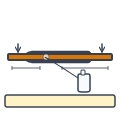
Add the Tail
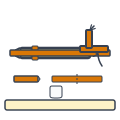
Glue half a popsicle stick across the back as a tail stabiliser. Add a small upright rectangle as the vertical tail fin.
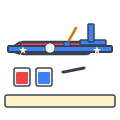
Paint Your Stunt Plane
Paint in bold racing colours and use markers to add a pilot number, stars, or lightning bolts on the wings.
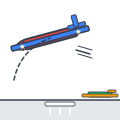
Test Flight!
Hold by the body and launch gently! Experiment with throwing angles and set up a landing strip to practise accuracy.
What You’ll Create
Calling all ace pilots! ✈️🌟 Your little aviators will engineer a miniature stunt plane from a simple clothespin and popsicle sticks — complete with wings, a tail, and a propeller! Paint it in racing colours, add your squadron number with markers, then send it soaring across the room on daring test flights. It’s engineering, art, and imaginative play all rolled into one!
Have fun!
- ✈️ Build a whole fleet of different planes and compare which design flies furthest!
- 🏆 Set up a target landing zone and score points for accuracy!
- 🎭 Create pilot characters for each plane and act out daring rescue missions!
- 📏 Measure the distance of each flight and keep a record — can you beat your personal best?
Why It’s Amazing
Engineering Basics: Placing wings for balance and adding a tail for stability introduces real aeronautical principles — kids learn why planes are shaped the way they are! ✈️
Fine Motor Skills: Gluing small pieces precisely, painting details, and assembling the plane develops excellent hand-eye coordination. ✋
Creative Design: Each plane becomes a unique creation — choosing colours, adding details, and naming their aircraft sparks artistic expression. 🎨
Physics Exploration: Test flights naturally lead to experiments with angle, force, and balance — hands-on physics through play! 🔬
Pro Tips
For ages 3–5: Pre-glue the structural parts and let them focus on painting and decorating. Fly the plane together — they’ll love chasing it across the room!
For ages 5–8: Guide them through assembly but let them handle the gluing. Encourage experimentation: what happens if the wings are further forward or back?
For ages 8–12: Challenge them to build multiple designs and test which flies best. Introduce the concept of centre of gravity — clip a small weight (like a paperclip) to the nose and see how it changes the flight.
Secret Pro Move: Use the clothespin’s spring mechanism! Clip a small folded paper “propeller” to the front — when you squeeze and release, the propeller spins for a split second before launch! 🌀