Indoor activity
Cardboard Tube Kaleidoscope
Build a working kaleidoscope from a cardboard tube and foil — look through the peephole and watch a dazzling, ever-changing pattern of reflections appear!
Materials
- Aluminium Foil
- Cardboard Tubes
- Cling Film
- Pen
- Scissors
- Tape
- Tissue Paper
Illustrated Steps
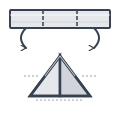
Make the Mirror Prism
⚠️ Adult Helper Needed — Cut a foil strip 3 cm wide and as long as the tube. Fold it into three equal panels lengthways to form a triangular prism with the shiny mirror side facing inward on all three faces.
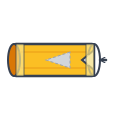
Insert the Prism
Slide the triangular foil prism inside the cardboard tube — shiny sides facing in, dull side out. It should fit snugly. Secure with a small piece of tape at each end to stop it sliding around.
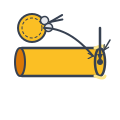
Seal the Viewing End
Cut a cardboard disc the same diameter as the tube. Pierce a single 4–5 mm hole in the centre with a pen tip. Tape this disc firmly over one end — this tiny eyehole forces your eye close to the mirrors.
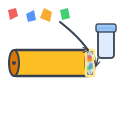
Create the Light Cap
Scatter small torn pieces of tissue paper in 3–4 colours inside the open end of the tube. Stretch cling film tightly over that end and tape it down all the way around to trap the tissue and let light through.
What You’ll Create
You’ll engineer a real, working kaleidoscope from a cardboard tube and aluminium foil! 🔭 Look through one end and you’ll see a breathtaking, symmetrical pattern of reflected colours — rotate it and the pattern transforms instantly. It’s optical magic built entirely from household materials.
Have fun!
- 🌈 Swap out tissue paper for tiny beads, sequins, or glitter for a dazzling upgrade.
- 🔦 Point the light end at different light sources — a lamp, sunlight, or a coloured light — to change the pattern.
- 🎨 Draw what you see through the eyepiece — it’s like designing a new geometric pattern every time!
- 🔭 Make a second kaleidoscope with a square prism (four panels) and compare the symmetry differences.
Why It’s Amazing
- Optics & Light: Children directly observe how reflections multiply and create symmetry — their first hands-on encounter with reflection physics. 🔬
- Geometry: The three-panel mirror creates 6-fold rotational symmetry automatically — a beautiful, concrete introduction to geometric concepts. 📐
- Engineering Mindset: Building something that actually works from scratch builds enormous confidence and pride of ownership. 🏗️
- Observation Skills: Describing what changes when you rotate the kaleidoscope develops scientific vocabulary and precise observation. 🔭
Pro Tips
For ages 6–8: Do steps 1–2 yourself and let them do the tissue paper and cling film end. The reveal moment — when they first look through and see the pattern — is pure magic!
For ages 8–12: Challenge them to make the foil prism more precise using a ruler and the back of a spoon to flatten each fold perfectly. A crisper prism = sharper reflections.
For ages 10–12: Research how traditional kaleidoscopes use glass mirrors and glass beads. Can they improve their design? Try adding a second cardboard tube around the first that rotates independently to spin the light cap while keeping the eyepiece still.