Indoor activity
Balloon Hovercraft
Tape an inflated balloon over a hole in a paper plate to build a hovercraft that glides across the table on a cushion of air!
Materials
- Balloons
- Paper Plates
- Scissors
- Tape
Illustrated Steps
Prepare the Base
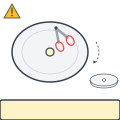
Poke a 1 cm hole in the centre of a paper plate and flip it upside down.
Inflate the Balloon
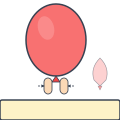
Blow up a balloon to medium size and pinch the neck closed — don't tie it!
Attach the Balloon
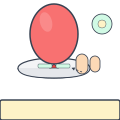
Stretch the balloon neck over the plate hole and seal with tape all around.
Launch and Glide
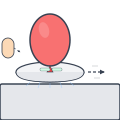
Place plate-side down on a smooth surface, release the balloon, and push gently!
What You’ll Create
A frictionless glider powered by air! 🎈 Your little physicists will poke a hole in a paper plate, tape an inflated balloon over it, and watch the plate hover and glide across a smooth surface on a cushion of escaping air. It’s like magic — but it’s science! Experiment with different balloon sizes and surfaces to see what works best.
Have fun!
- 🏁 Set up a race track with tape lines and race two hovercrafts against each other!
- 📏 Measure how far each hovercraft travels — try bigger and smaller balloons!
- 🎨 Decorate the plate with markers before assembling for a custom hovercraft!
- 🔬 Try different surfaces — does it work better on tile, wood, or carpet?
Why It’s Amazing
Air Pressure: The escaping air creates a low-friction cushion beneath the plate — the same principle used in real hovercrafts and air hockey tables! 💨
Friction Science: Comparing how the plate moves with and without air demonstrates friction in the most tangible way possible. 🔬
Experimental Method: Testing different balloon sizes, surfaces, and push forces teaches the scientific method through play. 📊
Engineering Fun: Sealing the balloon properly and finding the right hole size requires iterative problem-solving. 🛠️
Pro Tips
For ages 3–5: Adults should poke the hole and attach the balloon. Let kids inflate (if they can), push the hovercraft, and chase it around. The gliding is pure delight!
For ages 5–8: Let them do most of the assembly with supervision for the hole. Challenge them to predict which surface will work best, then test their hypothesis.
For ages 8–12: Run a proper experiment — test 3 different balloon sizes on 3 different surfaces, measure distance travelled, and record results in a table. Discuss why some combinations work better. Try adding weight to the plate — how much can it carry and still hover?
Secret Pro Move: Use a bottle cap (like a sports bottle cap that opens and closes) taped over the hole — you can control when the air escapes by opening and closing the cap, giving you much better control over your hovercraft! 🎯